
The Fed is sending hawkish signals. What scenarios should your bank or credit union be prepared for?
The Fed raised rates to 3.75–4% and signaled for more. The curve is bear-flattening, which squeezes margins and equity value at once.
By Alexander Demyanets, Chief Economist··4 min readThe Federal Reserve raised rates for the first time since 2023 on Wednesday, lifting the federal funds target range by a quarter point to 3.75–4%. The move itself was widely expected by markets, but the hawkish tone provided a new signal.
A hawkish hike
The FOMC statement was tough on inflation, which has now run above the Fed’s 2% target for five and a half years. The Summary of Economic Projections backed the stance: twelve officials expect another 25 basis point hike before year-end, and four project 50 basis points.
At the press conference, Chair Warsh leaned on the Fed’s inflation-fighting mandate and gave a sensible, if obvious, rationale for the decision: inflation is high, underlying pressures are not subsiding, and elevated energy prices raise the risk of second-round effects on wages and prices.
How markets took it
Markets had already priced the hike, but they had not necessarily priced the hawkishness. Both the short end and the long end of the Treasury curve sold off in response, with short yields rising more than long yields in a bear flattening move.
Fed funds futures and OIS swaps now price in a better than 80% chance of another hike by year-end. The 2s10s Treasury spread sits at about 25 basis points. There is a chance that the curve will keep flattening, and that more pressure on funding costs and net interest margins will continue.
Why a bear flattener hurts
A bear flattener is the hardest rate move for an institution whose funding reprices faster than its assets. Short rates drive what you pay on deposits and borrowings. Long rates drive what you earn on new loans and securities. When the short end rises more, funding costs climb faster than asset yields can follow.
The damage shows up in two places. Net interest margin (NIM) shrinks as interest expense rises against fixed interest income. Economic value of equity (EVE) falls because higher rates cut the present value of fixed-rate assets by more than they cut the value of short-duration liabilities.
An illustration from Delfi Overwatch
To put numbers on it, we modeled an illustrative, simple balance sheet in Delfi Overwatch: $100M of fixed-rate 1–4 family residential mortgages funded by $100M of floating-rate demand deposits. We ran it through six rate scenarios: static rates, the forward curve, and bear flatteners of 100, 200, 300 and 400 basis points.
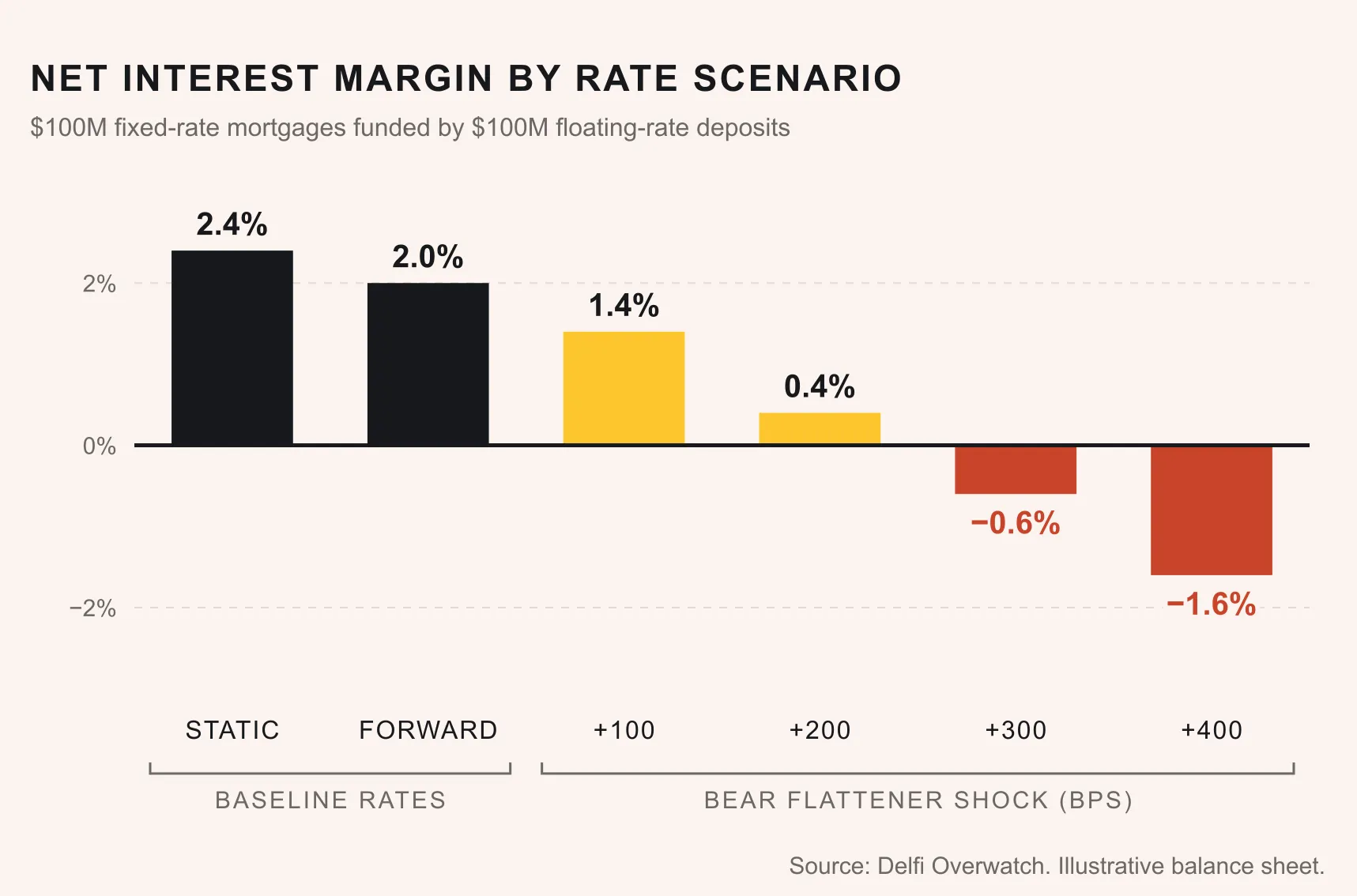
With rates unchanged, the balance sheet earns a margin of roughly 2.4%. The forward curve, which already embeds further tightening, trims that to about 2.0%. A 100 basis point bear flattener takes it to around 1.4%, and a 200 basis point move leaves almost nothing. At 300 basis points the margin turns negative: the deposits cost more than the mortgages earn.
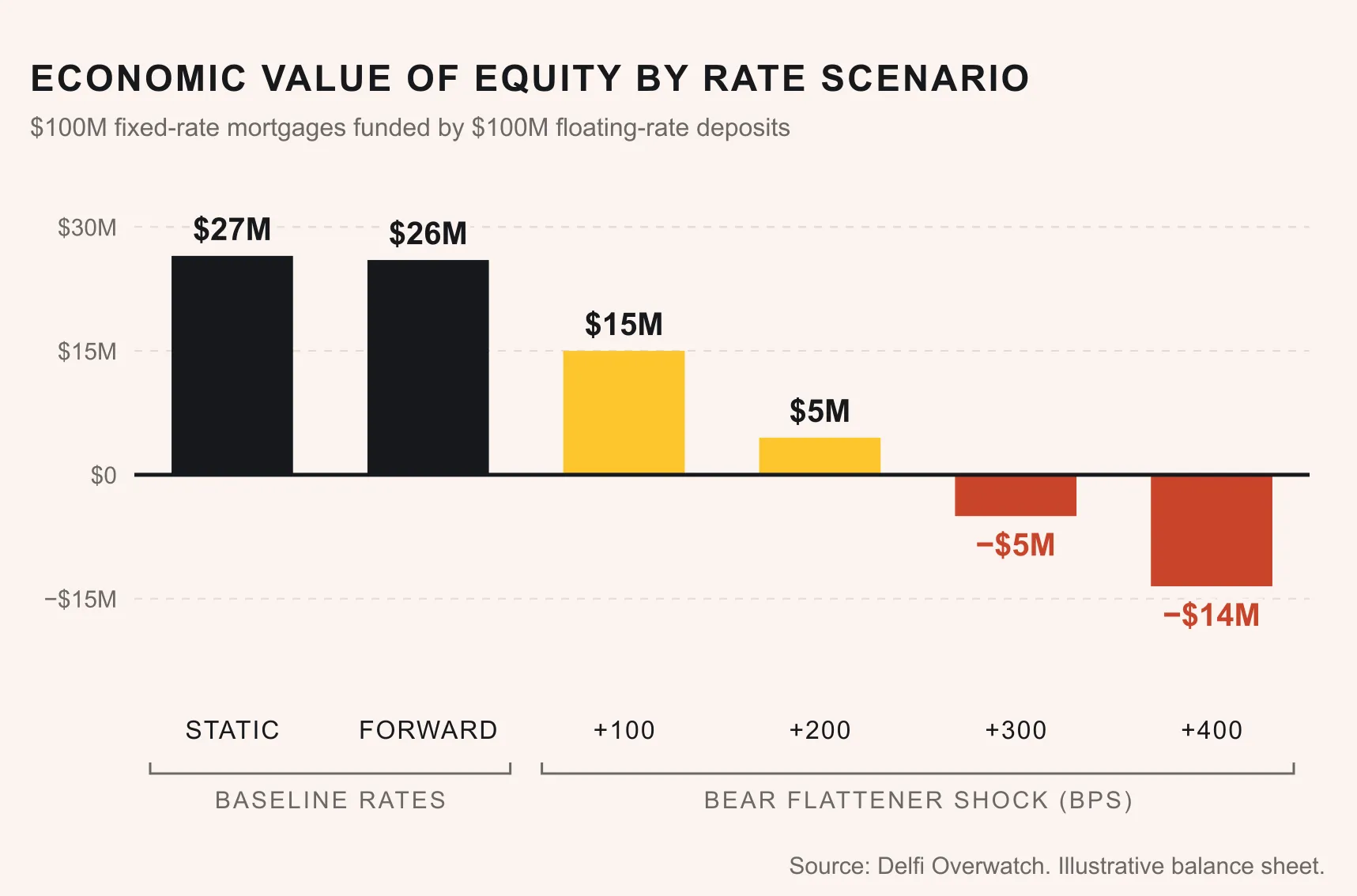
EVE follows the same path. It starts near $27M, falls by more than 40% in the 100 basis point scenario, and goes negative at 300 basis points. Earnings and capital value deteriorate together, which is what makes this scenario more dangerous than a parallel shift that many policy limits are built around.
No real institution is this concentrated. Actual balance sheets hold floating-rate assets, term funding, non-maturity deposits that reprice slowly, and hedges. But the direction of the result holds for any institution that is liability sensitive, and the example shows how quickly the numbers move once the short end does.
What to do now
- Add bear flatteners to your scenario set. Standard parallel shocks of plus or minus 100 to 400 basis points miss curve-shape risk. Run non-parallel scenarios alongside them.
- Look at NIM and EVE together. Earnings-at-risk tells you about the next year or two. EVE tells you about the value of everything already on the books. A bear flattener can hit both.
- Test your deposit assumptions. With another hike likely by year-end, betas and balance migration assumptions calibrated to a falling-rate environment deserve a second look.
- Check results against policy limits. If a plausible flattener takes you through a board limit, it is better to find out in a model than in a quarter-end report.
How does your balance sheet hold up if the curve keeps flattening? Contact Delfi for a free consultation on stress-testing your balance sheet.
Frequently asked questions
What is a bear flattener?
A bear flattener is a yield curve move in which interest rates rise across maturities but short-term rates rise more than long-term rates. The curve gets flatter while bond prices fall, which is what happened after the Fed's September 2026 rate hike.
How does a bear flattener affect net interest margin?
A bear flattener compresses net interest margin at institutions whose funding reprices faster than their assets. Deposit and borrowing costs follow short-term rates up, while fixed-rate loans and securities keep paying their original yields.
Why does economic value of equity fall when rates rise?
Economic value of equity falls when rates rise because the present value of fixed-rate assets drops more than the value of short-duration liabilities. An institution holding long fixed-rate mortgages funded by rate-sensitive deposits sees the largest decline.